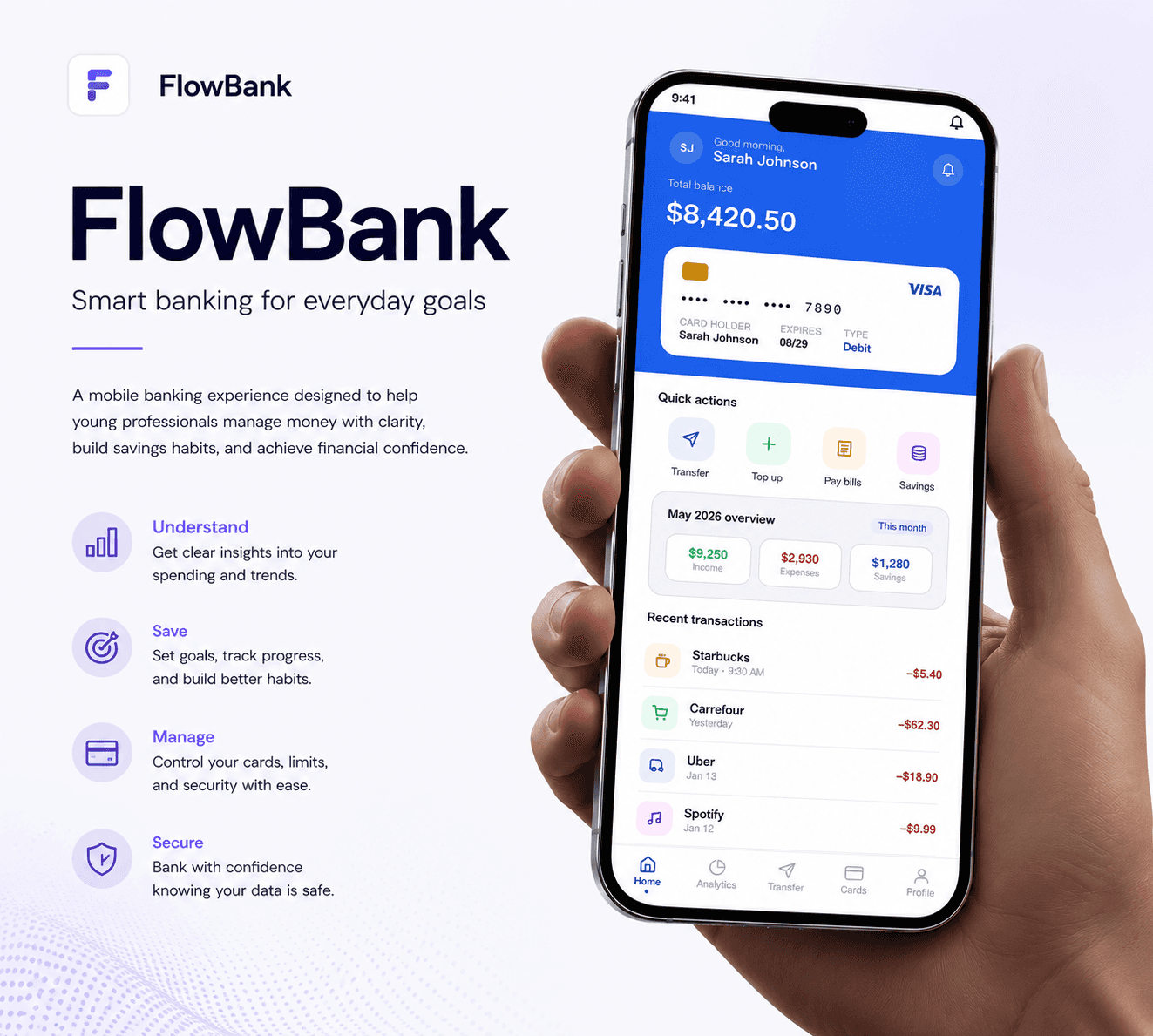
FlowBank
FlowBank is a mobile banking experience designed to help young professionals gain better control over their finances through intuitive budgeting, spending insights, savings goals, and card management features.
"The project focused on simplifying everyday banking interactions while increasing user confidence in managing money. The experience combines financial visibility, goal tracking, and actionable insights into a modern, mobile-first banking platform."
Client
Role
Industry
Date
The problem
Young professionals often struggle to understand where their money is being spent and find it difficult to maintain consistent saving habits.
Traditional banking applications focus heavily on transactions and account management but provide limited support for helping users build healthy financial behaviors.
Research revealed that users wanted:
Better visibility into spending patterns
Easier savings management
Simplified financial insights
Faster access to common banking actions
Greater confidence when making financial decisions
Research
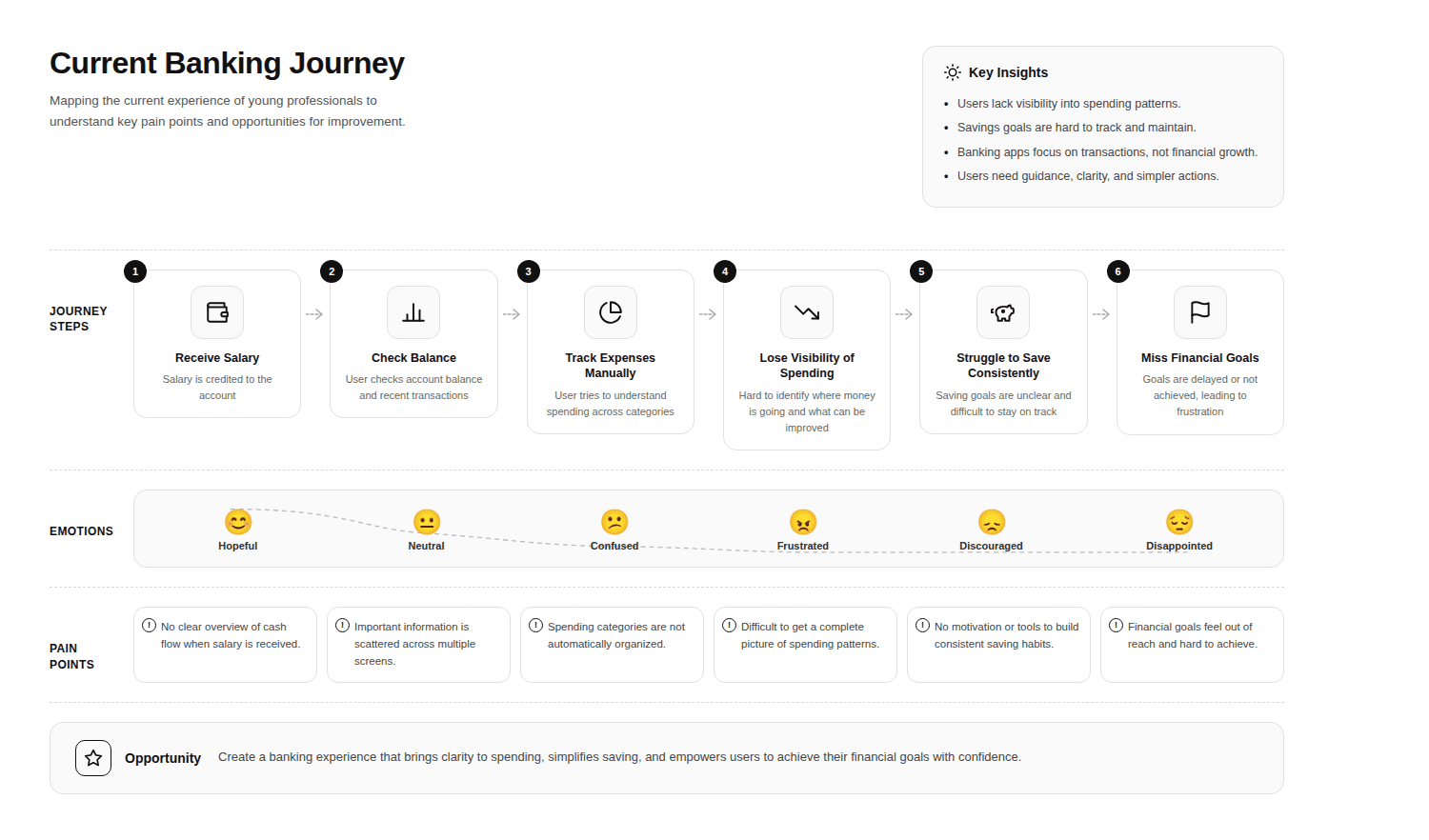
To better understand user needs and financial behaviors, I conducted a combination of competitive analysis, user interviews, user journey mapping, and heuristic evaluations of existing banking applications. The research focused on identifying common pain points related to money management, savings habits, transaction visibility, and overall banking experience. Insights gathered from the discovery phase helped define key opportunities for improving usability, increasing financial awareness, and simplifying everyday banking tasks.
Competitor Analysis :
To understand current market standards and user expectations, I analyzed leading digital banking experiences such as Revolut, N26, and Monzo. The analysis examined information architecture, transaction management, financial insights, savings journeys, and visual design patterns. Key learnings were used to inform product decisions and establish a benchmark for creating a modern, intuitive banking experience.
Key Findings :
68% of participants checked their account balance multiple times per week but rarely reviewed spending trends.
72% reported difficulty maintaining long-term savings goals.
Users preferred:
Visual spending breakdowns
Progress tracking
Quick access to transactions
Personalized financial guidance
User Paint Points :
Financial information felt overwhelming.
Savings progress was difficult to visualize.
Important banking actions required too many steps.
Spending habits were difficult to track over time.
The Solution
Designed a mobile-first banking platform focused on financial clarity and habit formation.
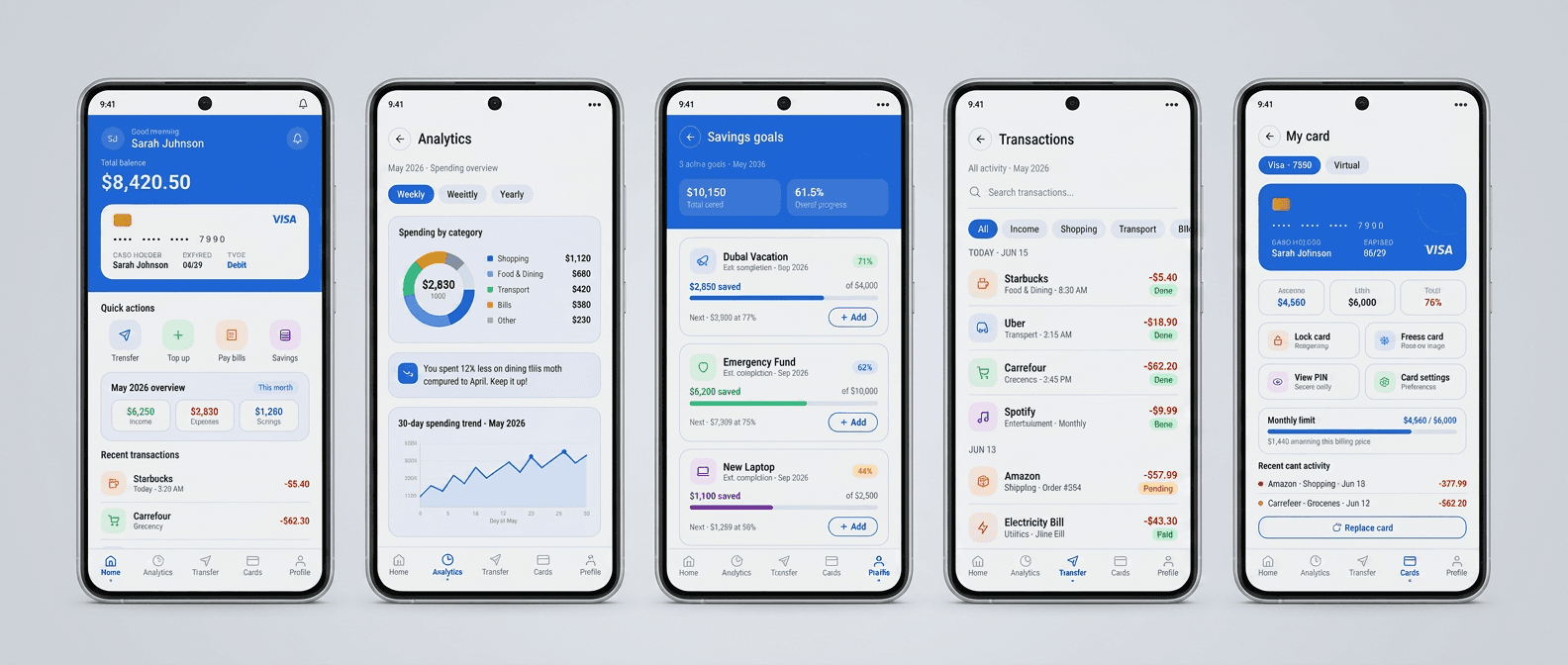
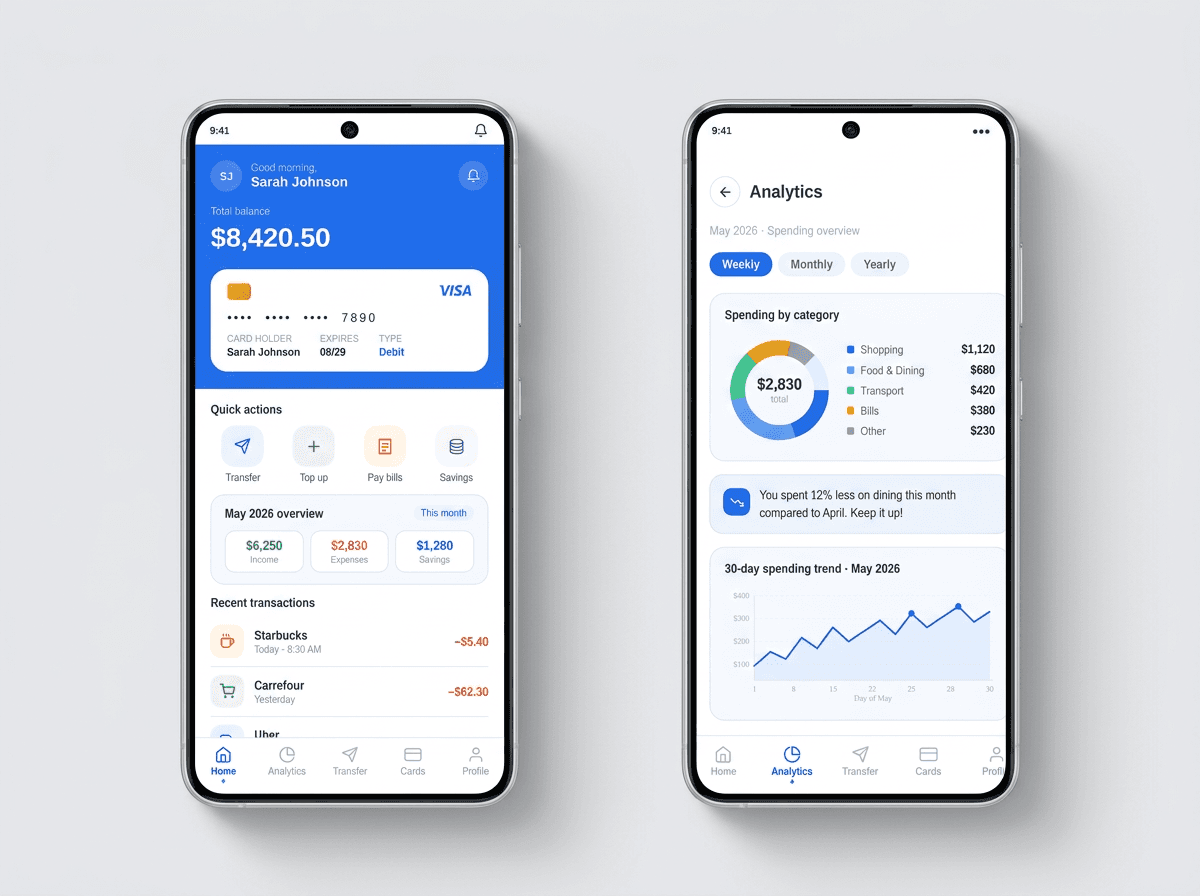
1 - Dashboard / Spending Insights
Dashboard
A centralized overview displaying:
Account balance
Quick actions
Monthly financial summary
Recent transactions
Spending Insights
Interactive analytics helping users understand:
Spending categories
Monthly trends
Financial habits
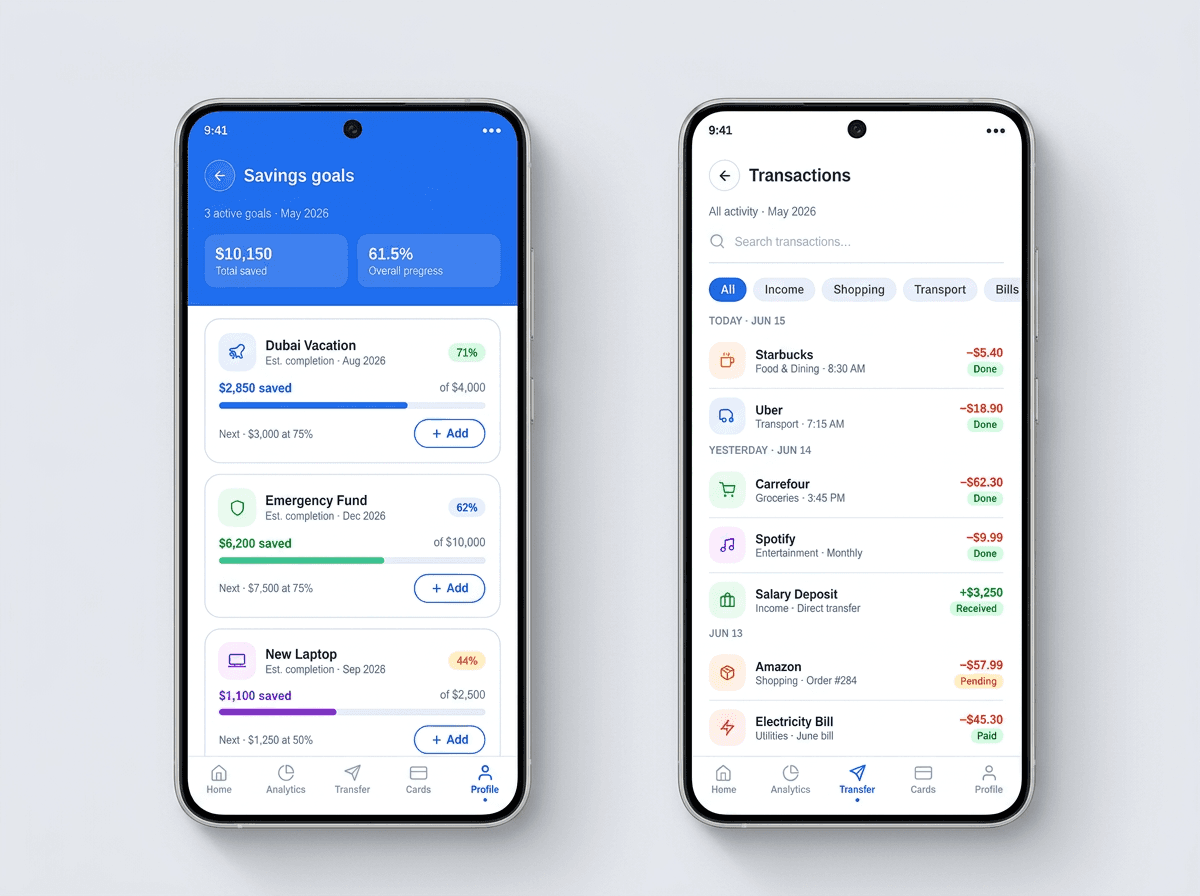
2 - Savings Goals / Transaction Management
Savings Goals
Goal-based saving experience allowing users to:
Create goals
Track progress
Monitor milestones
Transaction Management
Improved transaction visibility through:
Search
Filters
Categories
Merchant recognition
Challenges
Balancing Simplicity with Financial Complexity
Banking products contain large amounts of information that can easily overwhelm users.
The challenge was creating a clean experience without removing important financial details.
Building Trust
Financial products require a strong sense of reliability and security.
The design language focused on:
Clear visual hierarchy
Consistent layouts
Familiar interaction patterns
Transparent information presentation
Prioritizing Information
Users access banking apps frequently but for different reasons.
The dashboard had to support both:
Quick tasks
Deeper financial exploration
Key Takeaways
Designing for Trust Requires Simplicity
Reducing cognitive load increased clarity and made financial information easier to understand.
Data Should Drive Action
Users benefited more from actionable insights than from displaying raw financial data.
Goal-Based Experiences Encourage Engagement
Savings goals created stronger motivation and helped users build healthier financial habits.
Small UX Improvements Have Large Business Impact
Simplifying common banking tasks can improve engagement, satisfaction, and long-term retention.
Projects